Showing posts with label vintage books. Show all posts

Saturday, February 9, 2013

February Days: Dessert and Table Decor for Valentine's Day and More


The Better Homes & Gardens Holiday Cookbook  is such a enchanting mid-century cookbook (published 1959) that it is one of my favorite vintage books to share with you.  I often look through it for holiday inspiration.

The section for February included some charming home decor and food ideas for Valentine's Day and President's Day.  I now wish that I had a heart-shaped cake mold because this pink Valentine Cake is so delightfully easy to make (original recipe below) and would make a charming end for a romantic Valentine's Day dinner.

Note the silver or silver-plated "cake breaker," a cake cutter designed specifically for angel food cakes, pictured in the background, like this one on Etsy:


Valentine Cake

1 package white cake mix
1 package fluffy instant frosting mix
Red food coloring
1/2 cup flaked coconut

Mix cake batter according to package directions.  Pour into 2 paper-lined heart-shaped pans and bake at 350 degrees for 25 to 30 minutes.

Prepare frosting; tint pink with red food coloring.  Tint coconut pink (add food coloring to 1 tablespoon water until you get the color you want.  Put coconut in a jar; add colored water, cap jar, and shake until uniformly tinted.  Dry on a paper towel.)

Frost cooled cake.  Leaving a 2 1/2 to 3 inch border around the top of the cake, trace a heart in frosting and fill in with tinted coconut.


♥♥♥♥


The "February Days" section has additional food and decor ideas for Valentine's Day and President's Day that you might enjoy (click on the photo to enlarge):


The photo above shows another lovely centerpiece made with a paper doily, carnations, and one pink rose. And aren't those white heart-shaped dessert plates with the heart trim just perfect?

How are you celebrating Valentine's Day?  Do you cook a meal for yourself and your sweetie, go out to a restaurant, or do you ignore this day entirely (smile)? 



Sunday, August 19, 2012

Dishes Men Like: a Mid-Century Cookbook

A friend gave me a small stack of retro and vintage cookbooks this summer because she knows that I collect them.  I set them on my cookbook shelf and forgot about them until this week when I took a look at the pamphlet-style Dishes Men Like, a cookbook published by Lea & Perrins Worcestershire Sauce in 1952: 


Each of the 168 recipes uses Worchestershire sauce, and Lea & Perrins swears that the sauce is the "favorite of men in all parts of the country."  The subtitle on this book reads "new recipes and old favorites...easy to prepare...sure to please."  And with instructions like this:


this cookbook should have been a hit with men, right?

So I laughed out loud when I saw page after page after page of this:


Most of the recipes must have been terrible because the former owner has crossed most of them out!  Were these recipes not man-pleasing enough?  The only recipe on the page above that didn't get the axe was the recipe for Deviled Crackers, which are saltine crackers spread with butter (and Worchestershire sauce!) and baked in an oven.  Wow.

Some of the recipes sound less-than-appetizing though, so I don't blame the former owner for crossing them out.  Speedy Green Noodles De LuxeJellied Chicken Loaf.  Tuna Fondue anyone?

As I do the majority of the cooking in our household I just may whip up a Succulent Meat Pie or something and test it out on my husband.  I actually already have a bottle of Lea & Perrins in the fridge so I'm already prepared!

Dear readers, is there a recipe that you love to make for your family that is always a big hit?  Share it with us!


Friday, May 11, 2012

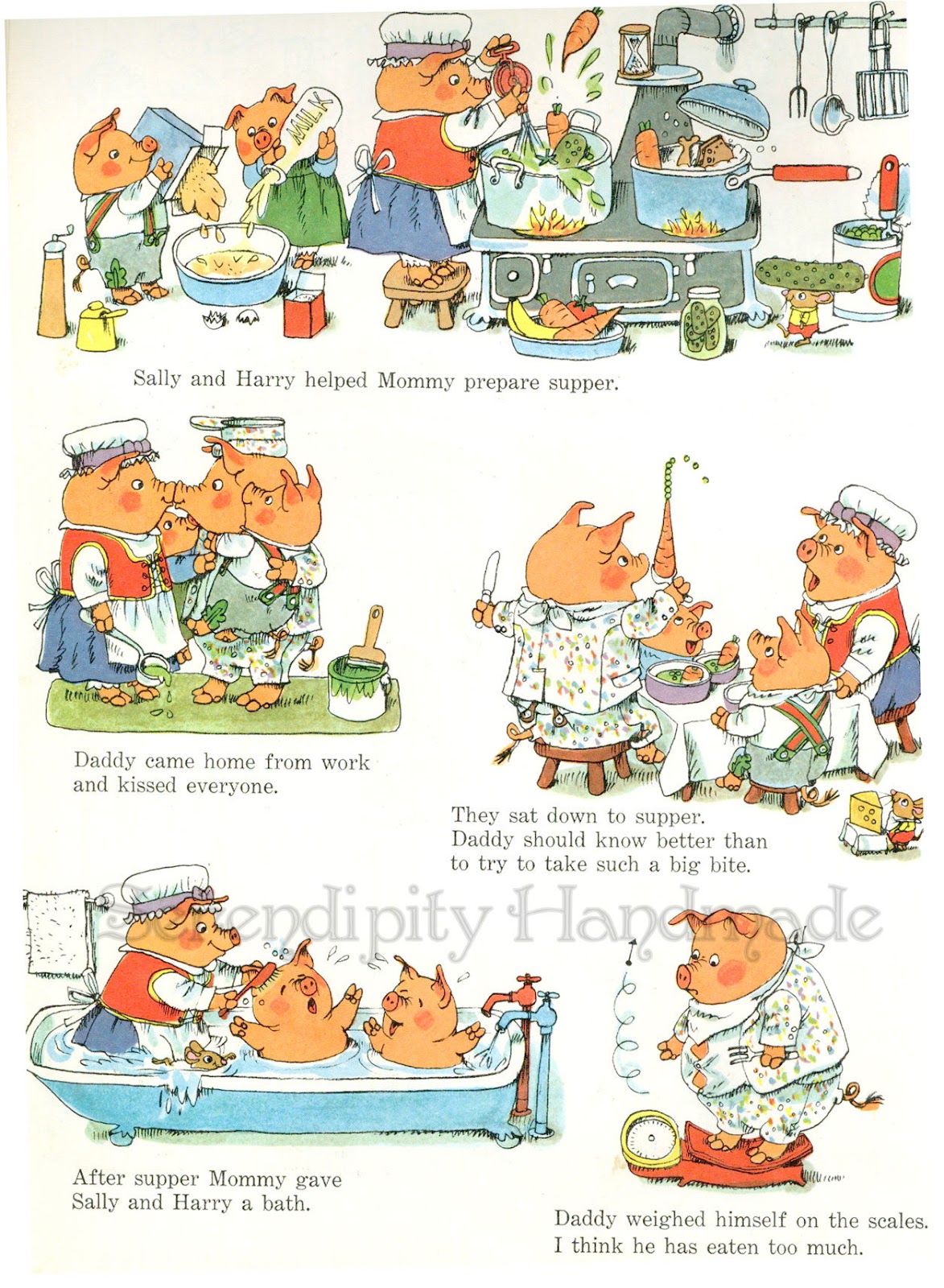
Mother's Work Is Never Done, a Tribute to Moms by Richard Scarry


I went looking for a gift the other day, and in doing so found a new copy of What Do People Do All Day? by Richard Scarry.  It was one of my absolute favorite books in the world as a young child.  The artwork is fun, bright, cheery and amazingly detailed as Scarry gave children a peek at the work-a-day world of making clothes, growing food, baking bread, building roads, and more. 

You can see how beat up well-loved my copy is compared to a brand-spanking new book:

What Do People Do All Day, 1968 vs 1979 abrdiged version, at Serendipity Handmade

I noticed that the newer edition is much shorter. I was surprised to find that four five of the chapters have been removed.  My copy is a first-edition published in 1968. The only edition of this book that you can buy today is the 1979 abridged edition.  How mysterious!  Why abridge a rather popular children's book? What could be wrong with it?

To start, the endpapers with some of the character art have been removed.  In it Scarry drew the residents of Busytown.  I agree that children really don't need to see characters like this anymore:

Spinster Susie, from What Do People Do All Day at Serendipity Handmade blog
Spinster Susie is literally a "spinster" of cotton into thread,
in the "Cotton and How We Use It" chapter (also removed)
However, the chapters about coal and electricity, the water treatment plant, and Sgt. Murphy the Busytown policeman were also removed.  Perhaps the technology in those chapters were a little dated, but frankly most (if not all) of the technology in the other chapters is also outdated.

Ok, but why remove Mother's Work Is Never Done, the chapter about a stay-at-home-mom?  SAHMs still existed in 1979 when the abridged version was published, and they were still working very hard.

Certainly more women with children entered the workforce in the late 1970s than in the 1960s when this chapter was written.  I imagine that perhaps it may not have been politically correct in the late 1970s to depict a woman / wife / mother / girls in a traditional female role.  In some ways this chapter does reinforce traditional roles.  Scarry does have Daddy Pig and Harry being served breakfast in this chapter, but later Harry rather un-traditionally for the time helps with the housework.  

Personally, I think Scarry was trying to equalize what was traditionally regarded as "women's work" when he wrote this chapter. Even today it's possible that a chapter like this one can help children (and adults) realize just how hard a SAHM works all day, and that the work is equal to the work that her partner does. 

Mother's Work is Never Done from What Do People Do All Day?

Mother's Work is Never Done from What Do People Do All Day?

Mother's Work is Never Done from What Do People Do All Day?

Mother's Work is Never Done from What Do People Do All Day?

Mother's Work is Never Done from What Do People Do All Day?

What do you think?  Is this chapter too dated for 2012?


Either way, I would just like to say Happy Mother's Day
to all you mothers out there, SAHM or not,
and thank you 
because your work really is never done!

Thursday, April 12, 2012

Fashion Cheats to Save You Money, Part Four of I Hate to Housekeep


It's true these days that most of the clothes that we buy are not built to last for more than a season (or two).  We all love a good bargain and love to show off a great bargain.  But some things we buy simply aren't bargains -- they don't last long enough to make it worth the expense, or worse yet, they look like a bargain (in Peg's words, they look "cheap").

Wouldn't you like some general tips about what type of clothing items you can save money on and still look good, and what you should save your pennies to buy?  In this final part of the I Hate to Housekeep series I'll share some of Peg's advice about your wardrobe that I believe has stood the test of time.


Fashion Cheats to Save you Money, I Hate to Housekeep, Serendipity Handmade
Doesn't the little girl in this Hillary Knight illustration look a lot like Eloise?

First a little advice from me: if you know the item is going to wear out quickly, I suggest buying it from the clearance rack, or even better, at a consignment or thrift store.

A personal example of this are cotton knit t-shirts because they are a basic wardrobe staple that I frequently wear with jeans. Over time they become stained, or the color washes out, or the cotton simply wears so thin that the fabric starts to look cheap. I'm not the type to spend upwards of $20 on a t-shirt so I know that it is best to buy low priced items that can head to the rag bag when they get ratty.

And here is Peg's advice about clothes you can cheat on -- in her words, "buy cheap" -- and get away with it, and those clothing items you should buy to last. Keep in mind that this is 1960s advice, apply it in terms of your wardrobe and lifestyle.  Some of us attend cocktail parties; some of us don't.

What You Can Cheat On
  1. Summer shoes. (You'll have probably worn things like flip-flops and espadrilles out by the end of summer if you wear them frequently).

  2. Summer cottons or synthetic dresses.  Peg says, "Dispose of them at the end of the season because at that point the cheap ones have lost their bounce.  If you don't dispose of them, you'll continue to wear them and they'll look their price."

  3. Cocktail dresses, especially bright ones.  Peg says, "It takes a trained eye to discern the difference between a flame-colored $22.95 number and a flame-colored $98.95 number, particularly after a couple of Gibsons."

  4. Jewelry, if you chose carefully.  (You know that you can get some fabulous-looking vintage costume jewelry at thrift stores, right?)

  5. Handbags, ditto. 

  6. Underwear, depending on your audience, if any.  (Ha ha ha!  Perhaps no one is looking?)

What You Can't Cheat On
  1. Girdles and bras.  (You've seen countless articles in women's magazines about being fitted for the correct size bra.  And the more you spend on your Spanx-like undergarments, the better they will smooth you out and hold you in and the longer they will last.)

  2. Shoes.  Peg says, "The trouble with cheap ones is that they lose their spurious good looks very rapidly but they won't quite fall apart so you go on wearing them."  (You put a lot of pressure and weight on your feet every day.  Whatever the size, shape, and height of the shoe, buy the best-fitting shoe that you can afford in order to problems like corns that occur because of ill-fitting shoes.) 

  3. Belts.

  4. Tailored suits, coats, dresses.

  5. Nylon stockings.  Peg says, "Finding the right brand, size, gauge, and denier can take some doing; but once done, they look much better than the grocery type or factory seconds."  (If you do wear stockings or tights to work, as part of costume events, or for formal events this tip is very true.  Cheap stockings look just that -- cheap.)

  6. Perfume.

  7. Gloves, except for short white cottons.  (Consider this especially if you live in colder climates and wear gloves frequently in fall and winter).
Do you agree with Peg's advice (and mine) Dear Readers?  When it comes to fashion, in what ways do you economize?  Tips, ideas, and stories are always welcome....

Saturday, March 17, 2012

I Hate to Housekeep Part Three: Chores You Don't Have to Do


This is one of my favorite chapters in all of Peg Bracken's little book, as she explains that there are many household chores that you really don't have to do, or chores that you don't have to do as often as the "experts" say you must. As she says, eventually these things will take care of themselves in one way or another.

So here's a few handy tips direct from Peg about what not to do in housekeeping:
  • Don't wax your floors. Water splatters make dull spots on wax and they show up more.
  • Don't iron pajamas, tea towels, or pillowcases. Just fold them neatly.  (Note from Collette:  who does this anyway?!?!)
  • Don't scrub dirty cuffs and collars. Wet them, then dip them in your powdered detergent so they resemble a little child's sandy feet at the seashore, then throw them into the washer.
  • Don't darn socks. Rub the sock heels with paraffin or soap after every three or four washings to preserve the heels. Otherwise, the lumps may give them blisters, and you'll spend on Band-aids what you saved on socks!
  • Don't clean darkened aluminum pans you've cooked eggs in. You can do it, by putting a quart of water in the pan and adding two teaspoons of cream of tartar, then boiling it for a while. But it will swiftly darken the next time you cook an egg. Just keep a pan for egg cooking purposed discreetly in the cupboard.
  • Don't polish furniture. Just give it a good coat of carnauba wax once a year and dust it occasionally thereafter, rubbing harder once in a while if there's a fingerprint. Next year, at the same time, wash off the old wax with soap and warm water and put fresh wax on.

Is there a household chore that you simply cannot stand? Peg has some advice for you:

"If there's a household job you particularly and truly loathe, don't believe the sunshine sisters who tell you you'll learn to love it if you do it their way.

I've read articles, for instance, on how to make ironing fun. You save it all up for the afternoon, they say, and you put on a Fresh House Dress. Then you open a window to catch the cool breeze, and you tune in the radio to your favorite program, and you sit on a stool behind your ironing board, and then you iron, pausing once in a while to crow with delight as you see the freshly ironed duds pile up.

But this is a lot of clam juice. You are still ironing; and if ironing makes you come all over introspective, you'd just better send your washing to the laundry. You can charge it off to Mental Health."

Until next time....

Saturday, March 3, 2012

I Hate to Housekeep: a Few Housekeeping ABCs


If you like housekeeping, this post is NOT for you.

To continue our series for those who have better things to do than clean house,  I'd like to share a few of the ABCs of mid-20th century housekeeping according to our dear Peg Bracken.  This excerpt is from the "Bride's Own ABCs" chapter in The I Hate to Housekeep Book.   My particular favorite is Instant Housekeeping, which I plan to try sometime.  Unfortunately, my husband reads this blog so I'll have to wait a while until he's forgotten this post.

A is for Alphabet

"The alphabet is a handy thing to have around the house.  For instance, you can organize your canned goods with it, Applesauce to Zucchini.  Also whatever is in the medicine cabinet, Aspirin to Zinc ointment.  Also your herbs and spices, Allspice to Thyme."

E is for Equipment

"Once you've acquired the basic biggish things for cleaning, washing, and cooking, proceed as porcupines are said to make love:  quite carefully.  Borrow the gadget first, if you can.  Swap something for a week, in return for your sister-in-law's deep-fat fryer, to find out if you'd really use it if you had one.

Think of the attachments attachable to any self-respecting modern vacuum cleaner!  At least six...all of which you are privileged to use before you drag out the wax applicator and the floor polisher.

But Great-Grandma moved gently behind her broom for a while, then laid the dust with the polish-soaked dustcloth she fished out of her Mason jar, and had time to sit down to read Love or Lechery:  The Story of a Good Girl's Temptation, and a rattling good story it was, too."


I is for Instant Housekeeping

"This is for those occasions when you're going to be out of the house all day, but you don't want the house to look like it when your husband gets home.

Therefore, the minute he leaves in the morning, you steam into your Instant Housekeeping, which is usually housekeeping backward.
For instance, your own crash-plan might be:

1.  Set the table for dinner
2.  Build a modest pitcher of Martinis and set in the refrigerator
3.  Lay a fire
4.  Throw out the dead flowers
5.  Shut all the closet doors and cupboard drawers
6.  Do the breakfast dishes
7.  Make the bed

Then you can sweep, dust, and all that sort of thing, if there's still time.  But remember, when life is rich and full, and the chips are you know where, do last things first."

P is for Plastic Bags

"You will thank yourself for buying only bread that comes in reusable plastic bags and keeping all the bags.  You can use these bags in 500 different ways.  For instance:

1. Put one on each foot to protect good shoes if you must cook when you're dressed up
2. Use them in your dresser drawers as
  • lingerie cases
  • glove cases
  • hosiery cases
  • handkerchief cases
3. Freeze dampened clothes in them, when you get tired of ironing before you've finished
4. Use them as shoe covers when you travel
5. Put wet bathing suits and caps in them
6. Pack food in them for picnics
7. Slide them over ice-cream cartons to catch drips
8. Put cookies or leftover muffins in them to freeze
...plus 489 other purposes there isn't room to list here."

Z is for Zipper

"You aren't so apt to have trouble with them if you make sure they're zippered shut when you throw the clothes into the washer."

I hope that all of you reluctant housekeepers enjoyed this set of tips.  Until next time....


Friday, February 24, 2012

I Hate to Housekeep: Part One in a Series for the Reluctant Homemaker


As we are about a month away from the equinox and the turning of the winter into spring, I thought it would be a good time to introduce you to the vintage wisdom of the sarcastic and smart Peg Bracken, author of The I Hate to Housekeep Book:  When and How to Keep House Without Losing Your Mind. 

Each year I welcome spring, and each year I could do without the dreaded Spring Cleaning that I feel compelled to do each year regardless of how much I hate it.  I figured that some of you probably feel the same way.   Let's stay sane together during the Big Clean-up.

There are three kinds of housekeepers.  There is the spotless housekeeper, who won't stop, and there is the spotful housekeeper, who won't start.  Then there is the occasional or random housekeeper, whose book this is.

Peg's books about cooking, household, and etiquette, written in the early 1960s, filled a empty niche and became runaway bestsellers.  Heloise and Emily Post have their place, but it was Peg who offered useful advice to women who were honest enough to admit that they had better things to do than be Housekeeper of the Year.  And her books were charmingly illustrated by the incredible Hilary Knight, whom you may recognize as the illustrator of the Eloise books.  I have three of them because I adore her snarky wit.

This book is not for the Betty Crocker types of the 1960s or the Martha Stewart-wannabes of our modern day.  Peg wrote this book for the women, as she described them, who set the automatic timer on the oven to start dinner -- and then forget to put the food in.   Women like me.

You never heard another woman say, "I simply adore Marcia, she's the most meticulous housekeeper!"
Before we delve any further into Peg's genius for housekeeping without tears, there is some very important advice for you and I to keep in mind:

 Act immediately on whatever housewifely impulses come your way.

As Peg states, "...forget the old cliche that anything worth doing is worth doing well.  This isn't true.  When you're going at a high lope, a fast swipe at the sink is a lot better than no swipe at all."

My thoughts exactly. If I'm in the mood to do a load of laundry I had better NOT ignore it, or we run out of clean underpants around here.

I will share more timeless advice next week.  In the meantime, stop polishing those copper pots and give your dust catchers tea cozies to charity.

Thursday, November 17, 2011

Vintage Recipe: Chicken Caruso


A few weeks ago I mentioned that I was looking through my cookbooks looking for new recipe inspiration, and I found it in Betty Crocker's New Dinner for Two Cookbook:


I turn to the Betty Crocker cookbooks for straightforward, basic American recipes that tend to turn out well every time, though I usually need to embellish with a few more spices because I like my food well-seasoned. 

I decided to try out the Chicken Caruso recipe as-is because I figured that the combination of ingredients would be pretty flavorful, perhaps even worthy of an aria as the dish is named after legendary tenor Enrico Caruso.  And how can you go wrong with a dish that includes both bacon and cheese? Here's the scanned page from the book (it includes a few other recipes too):


The only change I made was that I used egg noodles instead of macaroni because that is what I had in my pantry.

Here's the final result:


Unfortunately, this dish turned out to be just so-so.  I really wanted this to be good (I love bacon!  I love cheese!) but I found the ingredients to be too tame or too greasy.  First of all, it was a pea-fest -- the one cup of peas really dominated the flavor of the dish, and even though I like peas a cup was way too many.

This dish could benefit from the addition of more spices; I think a pinch of red pepper flakes when sauteing the onion and green pepper would really boost the flavor.

I'm also not surprised that Americans have such a high rate of heart disease given dishes like this one -- bacon grease and the fat from cheddar cheese made this a fat bomb -- you can see from the photo how slick the noodles are.  And both the cheese and the bacon really weren't that noticeable because of the peas!

Still, I'm not ready to give up on this cookbook yet.  Dear readers, if any of you have made successful recipes from this book I'd like to hear about it!


Wednesday, October 12, 2011

Vintage Cookbook Inspiration

By the way, don't forget to enter the vintage-inspired kitchen towels & menu planner giveaway as it ends this Friday!
 
I haven't felt like cooking in what seems like ages.  And thus I haven't shared any recipes.  The weather is finally starting to become crisp enough in the evenings to inspire me to turn on the oven. Fall is one of my favorite times of the year for cooking, as root vegetables are plentiful and the season just calls for hearty casseroles, soups, and roasts. 

 I was thumbing through my cookbooks the other day for some new ideas when I rediscovered my copy of Betty Crocker's New Dinner for Two Cookbook from 1964.


I've actually never used it! Yet this cookbook is a gem.  It has recipes broken into regional favorites (such as the East, the Southwest, Midwest), seasons (so there is a menu for fall), quick dinners, dinners for company, thrifty dinners, and tips and tricks.  There are a great variety of recipes here, from Minute Steak to Lobster Tails.  How did I overlook this cookbook?

Doesn't this roast pork look yummy?  It's the perfect fall menu , as apples are at their prime and squash is in season:


 Some of the menus contain a helpful timetable:


Why don't ALL cookbooks have schedules?  And all cookbooks should have charming illustrations too:


I think it might be fun to try a mid-century recipe or two and let you know how it turns out.  What are some of your favorite fall recipes?


Wednesday, June 15, 2011

Vintage Thingies Thursday: Rosey Grier's Needlepoint for Men

Father's Day is almost here, and what better way to celebrate than why commemorating those crafty men out there. For this Vintage Thingies Thursday, I bring you Rosey Grier's Needlepoint for Men, published in 1973:


Some of you may remember that Roosevelt "Rosey" Grier played football for both the New York Giants and the Los Angeles Rams in the 1960s and later he began a successful acting career.

This is a fortunate find from a used bookshop, and I just couldn't put it down. I don't think that there is another book like it in existence! How could someone just give this rare little gem up? It is signed by Rosey himself:


A couple of photos of Rosey in action:


Surrounded by a few completed projects.  I like the frog pillow:

The caption says, "Me, with most of my menagerie.  I may be too old to sleep
with a panda, but I sure can needlepoint one."  Too cute.

An example of one of the easy needlepoint designs in the book for the guy into sports (and by the way, enlarge the photo and you can print it out and use it too!):


A photo of Rosey with a finished commissioned canvas:


I hope you enjoyed this edition of Vintage Thingies Thursday.  Be sure to visit the other participants at Coloradolady's blog.  And a happy early Father's Day to all the dads out there, including my own, who played poker with Rosey a few times and told me that he's a really nice guy!

Wednesday, February 23, 2011

Vintage Thingies Thursday: The Leslie Uggams Beauty Book

For this Vintage Thingies Thursday I bring you the third beauty book that I loved as a young woman and spurred me to collect books in this genre: The Leslie Uggams Beauty Book.


I had no idea who Leslie Uggams was when I was younger, but I immediately admired her beauty, gracefulness, and poise that positively leapt from these pages. Her book was published in 1966 and is one of only two books that I have found from that era to be intended for African-American teens.

I'd like to share with you a few pages from the chapter about hair care, and along with the usual advice about keeping hair clean and visiting the salon, Leslie dealt with a topic that is just not covered in teen beauty books today: wearing a wig! Actually, the section begins, "Wigs are Wonderful -- But Not for Teens," although these were a common beauty accessory in the 1960s, along with hairpieces and switches, due to the expense of getting a really good human hair wig at the time ($150).

The following photos show Leslie's "favorite hairstyles" that were so typical of the 1960s:


Here is Leslie's own Personal Feminine Program that she shared with her readers that they might take pride in being feminine. In her words, to be feminine is to add a "something extra that makes the difference between a well-groomed girl and well-groomed 'girl' girl":

1) A bubble bath each day; sometimes an extra quick shower after a show or rehearsal.
2) Regular use of an after-bath fragrance.
3) Daily use of a deodorant or antiperspirant.
4) Brush teeth regularly; always use a mouthwash.
5) Keep underarms neat by shaving regularly.
6) Rinse out lingerie each evening so it's always fresh when I want to wear it.
7) Keep a frequent check on the cleanliness of my nails, hair, and skin.

One of the unusual sections in this book, considering that it is a beauty book, is a short paragraph on the Importance of Education for young women, including college, though Leslie seems to stress alternatives to college such as vocational school. That said, she does recommend choosing a career that a woman can "set aside or work at part-time when starting a family," one that she can pick up again later. Although this advice may seem a bit dated in light of the reforms of the Women's Movement, consider that in 2011 some of the families I know do have one mostly stay-at-home parent who works just part-time because child care continues to be very expensive in this country.

I hope that you enjoyed Leslie Uggams' Beauty Book this Vintage Thingies Thursday (be sure to visit some of the other posts at Coloradolady's blog), and by all means, leave a comment!

All photos are credited in each picture above.


Thursday, September 23, 2010

Vintage Thingies Thursday: Oh Dear! What Shall I Wear?


For this Vintage Thingies Thursday  have a peek at chapter one from my well-worn copy of Oh Dear! What Shall I Wear!, a Complete Guide to Dress for Every Occasion, published in 1946 by Helene Garnell. (If you missed the 40s fashion collage from the frontispiece of the book, click here).  Ms. Garnell's witty and sarcastic tone makes this tome a fun read, I'm amazed that 60 years after she wrote it, the advice in Ms. Garnell's book still applies to today's "Mrs. Average Woman":

  • Plan your wardrobe.
  • Keep it simple.
  • Be sure it is appropriate.

Chapter one is entitled, "I Haven't a Thing to Wear!"  (How many times have we said that while staring sadly into our closets?).  Just click on each image to enlarge the picture and read the text:


Enjoy, and be sure to stop by and visit the other Vintage Thingies Thursday party-goers today!

Monday, September 13, 2010

Madison Avenue Monday: Oh Dear! What Shall I Wear?


I've been thinking about fall fashion this week, so instead of an advert, here is a charming collage from the book Oh Dear! What Shall I Wear, published in 1946 by Helene Garnell as the "Complete Guide to Dress for Every Occasion."

Thursday, April 15, 2010

Vintage Thingies Thursday: Bubble Bath and Hair Bows

For this edition of Vintage Thingies Thursday, I am going to share one of the beauty books in my collection that I mentioned in a earlier post. Bubble Bath and Hair Bows by Mallen DeSantis was one of the beauty books that started my collection. It was published in 1963 and is about the daily grooming habits of a little girl named Jean Ellen. 

I have an ex-library copy as I wasn't so much concerned about the collectible nature of this book as for the content that establishes a child's wardrobe in the early1960s.  You can still find copies of this book as they are not very scarce.


I was a young teen when I found this book, and the only parts of this book that held any fascination for me then and now are in the last two chapters, Wardrobe and Clothes. The last two chapters about Jean Ellen's 1960s little girl wardrobe discuss what she wore, the different outfits she wore on various occasions, and how she took care of her clothes. 

One of my favorite pages is about how Mary Ellen took care of her gloves because my mother told me that her mother taught her to wash out her white gloves after each use.

So here are some of the pages that teach us what many (middle-class) young girls wore in the early 1960s.  Click on the photos to enlarge them so you can read the text:


I hope that you enjoyed this edition of Vintage Thingies Thursday.  Don't forget to visit Coloradolady's blog for more vintage things today!