Showing posts with label fortunate finds. Show all posts

Friday, May 3, 2013

Fortunate Finds: the Lady Ellen Pop Up Hair Salon


As a woman who is fascinated by the beauty rituals of yesteryear I happened to pass by a small plastic box at an estate sale.  It looked a bit familiar to me, so I opened it up and discovered that I had a Lady Ellen Pop Up Hair Salon in my hands:


This compact little box doesn't look like anything special on the outside, really, but I think this set is a triumph of mid-century design (probably made around the late 1950s or early 1960s or so).  This box of hair curlers looks pretty similar to one that my grandmother had, which is why it caught my eye.

When the box is open the graduated curlers are flat.  The lid itself contains clear plastic stakes that rest inside of the curlers when the box is closed and not in use.  However, if you open the box and place the lid underneath it, the stakes push up hidden pink plastic cylinders:


The internal pink cylinders then  push up the stacked set of graduated plastic curlers so they become easier to grab!  I love that idea.


Ingenious design, isn't it?  The curlers are also color-coded by size.  This set would have contained clips to hold the rollers in place but they are missing from this box.  (Hair clip design hasn't really changed in the last 60 years.  A metal prong clip is the type that would have been used.)

These sets were made by the Kaymar Company in Los Angeles into the early 1970s (as far as I know) with several different designs for the outer case (the designs were colorful and were "flower-power" bright in the late 1960s and 1970s).

Does this set of hair curlers look familiar to you too?

Tuesday, April 9, 2013

Re-purposed Vintage: the Art-o-Mat Vending Machine

Restored vintage cigarette machines + art = the Art-o-Mat!
 
Art-o-Mat at the American Conservatory Theater in San Francisco. 
Photo via Facebook
I do believe this is one of the coolest re-purposed/recycled vintage projects I have ever seen.  These former cigarette machines now vend a cellophane-wrapped carton of art!  The Art-o-Mat is the brainchild of Clark Whittington from Winston-Salem, North Carolina.  He refurbished his first cigarette machine in 1997 and now there are over 100 machines nationwide in the United States (you can find one near you by clicking here). 

Over 400 different artists now participate in the Art-O-Mat project.  On a recent trip to Northern California I had the opportunity to spend a a couple of hours at the Crocker Art Museum in Sacramento.  I spied the Art-o-Mat machine near the gift shop on the first floor when I first entered the museum:


A closer look at the contents:


I had planned to purchase the origami pack and visit the museum gift shop after visiting the exhbits but I completely ran out of time (I had a plane to catch). So I went hunting on the web for some of the art and artists in the different machines. This textile design by Aimee Alexander is pretty cool:

via the Art-O-Mat website


I also like this pinhole camera and print set by Rebecca Sexton Larson:

via the Art-O-Mat website


The restored machines are works of art themselves. Here are a couple of my favorites:

At the Emerge Gallery in North Carolina
photo via the Art-O-Mat website

At the Reynolda House Museum of American Art in Winston-Salem, NC
photo via the Art-O-Mat website


Find out more about the Art-O-Mat project at their website. I think it's a fun way to discover new artists and collect original art, and I hope to visit more of them in the future.  

Thursday, March 14, 2013

Toy Sewing Machines

Did you have a toy sewing machine as a child?  Today's sewing machines for children seem to be little more than disposable plastic junk that may or may not actually sew, but the toy sewing machines of yesterday are really a work of art.

I recently had the opportunity to see the incredible private collection of some expertly restored antique toy, portable, and cabinet sewing machines that dated from the 1850s to the 1950s. I really am amazed at the number of working sewing machines that have been produced over the years just for children to use.

This is a working antique Ideal Child's Toy Treadle Sewing Machine that dates to the late 1800s (it was probably made between 1880-1890):


The stand is only two feet high, and the base is made of cast iron. Isn't the scroll work on the treadle lovely? These toys machines were produced by several different companies in the US and Britain; this one was made in the United States and would have sold for around $5.00 in its day!   Here is a closer look, pictured with a small Mauchlin ware Clark's spool box with Clark's thread:


I can't help but show you this miniature hand crank machine (yes, it works) even though I do not have maker, model, or date information.  This is not the best photo of it, but it is the only one I have in which you can compare its size to the gentleman that is holding it!  I dub it "The Lilliputian":


However, the sewing machine that really charmed me (and made me green with envy, pun intended) was this perfect mint green Elna Junior from 1956, pictured next to its original red tin case:


The machine has all of its original parts and includes a working music box!  Can you imagine a little girl sitting down to sew while listening to the Blue Danube waltz?

Here's another view of the machine, case, and contents from a mint green model owned by the Brussels Toy Museum:

photo (c)Musée du Jouet de Bruxelles
 
I can't confirm this tidbit of information, but I heard that only 45,000 of these toys were made in 1956, and of course that makes them scarce today.

It took some searching but I found a You Tube video in which you can see (and hear!) a dark green Elna Junior with a working music box:


I wish that toy sewing machines were as beautifully made today; the examples I've shown you above work and are actually useful.   I don't need another sewing machine, but I'd love to have one a  mint green Elna Junior.  If you find one in good working order and want to part with it be sure to drop me a line!

Friday, December 21, 2012

Fortunate Finds: the Original Fashion Plates by Tomy


EDIT, 2015: Kahoots Toyz has produced a new version of the classic Fashion Plates Designer Set! And the original plates also work with the new version. Hooray!


With Christmas right around the corner I thought it would be fun to take a walk down Vintage Toy Memory Lane:  do you remember Fashion Plates?  


Fashion Plates was first introduced by Tomy Corp. in 1978 as "the kit that helps young designers, 6 and up, create fashions.  Hundreds, thousands, even millions of fashionable combinations can be created."  More Fashion Plates was a later expansion pack of 15 extra plates that added more model, clothing, and texture design options.

This toy kept me occupied for hours with no batteries required!  Basically, you selected two or three model and outfit plates and then placed a blank piece of paper over the plates.  Next, you rubbed the "special crayon" over the plates to produce an image:


Here are some possible combinations from the base kit and the expansion plate set:
 
 
You may remember that the back of most of the plates had texture options.  After transferring the design with charcoal you placed these plates back underneath the picture and transferred one or more textures with a colored pencil.  Texture options included stripes, plaids, flowers, stars, and more:


I picked up both of these sets at Goodwill a few years ago and it was truly a fortunate find as both sets are complete and in very good condition.  As you may know, this toy is highly collectible right now and at the time of this writing the Fashion Plates base set can easily fetch $100-150 at auction.


Today there are similar fashion plate type of toys such as this one by Melissa and Doug or a Barbie-themed version by Mattel.  The Project Runway Travel Fashion Design Light Box has a similar concept but involves more actual drawing.

The set I bought had a few designs left inside from the previous owner, a Miss Kristin Meier, and they really took me back to my childhood!  If you were anything like me you spent hours creating new outfits and coloring the designs.  But having been a perfectionist from my earliest days I was often a little frustrated that I would end up with extra black smudges around my picture after rubbing it over the plates.

The picture below belongs to Kristin, Fashion Plates Designer Extraordinaire, who apparently mastered the transfer technique at a very young age -- no extra charcoal smudges plus a lovely coloring job inside of the lines:


I wonder if she went into fashion design? 

Naturally I colored my own, for old times' sake:


I still need more practice with the charcoal.  But I had a good time anyway!


Thursday, November 8, 2012

Fortunate Finds: Disney Cinderella Apron Pattern by J.C. Penney

I stumbled over this gem of a pattern at an estate sale:


This is a giveaway promotional pattern from J.C. Penney department stores that tied in with the 1950 release of Walt Disney's Cinderella film. It's in decent condition considering it's age, even though it is foxed and wrinkled.  I'm happy to say it is unused.
 
I am dating it to precisely 1950 because the Advance dress pattern mentioned at the bottom of this page (Advance 5406) dates to the 1940s, and Cinderella was first released in 1950:


 The caption above reads: "Trust a Parisian to know style!  Both Jaq (at right), who's French, and Gus-Gus (left), who's strictly Disneyland, appreciate the chic of those Sorority rayon prints at a thrift 98 cents a yard.  The dress Cinderella's wearing with her dress-up apron here is Advance Pattern 5406."

Of course this giveaway pattern was intended to promote Penney's fabric department. I wish I could buy rayon prints for $.69 a yard today:


It is magical, as our Fairy Godmother tells us below!  The apron can tie and the back, front or side, and as you can see the fabric choices are limitless and it can be trimmed  in various ways.  I think I will have to sew this one for myself; it's just too cute!


Bibbidi-bobbidi-boo!

Thursday, September 27, 2012

My SX-70 Land Camera + 1972 Eames Ad = Nostalgia

My favorite piece in my small but well-loved Eames collection was not actually made directly by the Eames' at all:


It is a Polaroid SX-70 Land Camera.  Mine is an Alpha 1 series produced around 1977 that retailed at the time for about $233.00. It is finished in leather and chrome, has an attached leather strap, and a screw mount to allow attachment to a tripod.  It's in excellent physical condition, although you can see that it does have a little scratch on the front.

It came with an original leather Polaroid case, with suede interior, and an instruction card demonstrating how to pack the case, but unfortunately I do not have an instruction booklet:


This was a super-popular camera in the 1970s despite the high-end price tag, as the SX-70 camera was a significant technological achievement in internal and external design:


It was also the very first camera to use Polaroid's integral film, or film that developed on its own, without help from the photographer to time the development or peel the negative apart from the positive.

I bought this camera in 2005.  Unfortunately I had very little time to play with it before Polaroid phased out the Time Zero film that it requires to work (phased out in December 2005, sold out everywhere in March 2006).  I had hoped to try doing some Polaroid manipulation (watch this cool video if you want to know more about it), but as it turned out, this camera needs some internal work as some of my photos would develop properly, and others had a shadow across the final developed image. So sad!

Then I found out that the Impossible Project actually purchased a Polaroid film manufacturing plant and in 2008 began producing PX 70 Color Shade film that will work with my camera, but at only eight exposures for $23.00(!) I haven't been too keen to purchase such a high-priced film knowing that my camera needs a little restoration work. 

So where do the Eames' fit into this story?  In 1972, Charles and Ray Eames produced a wonderfully nostalgic ten minute film to advertise the camera, and includes a fascinating section about how the camera and film actually work. The ad has the Eames' stamp all over it:  the work is unhurried, whimsical, multicultural, and fun.  I enjoy watching this short film/ad just for the pleasure of enjoying Ray Eames' set design.

The film starts off a little slow, so if you'd like skip the first boring minute or so about Alfred Stieglitz and Edwin Land, the founder of Polaroid and maker of the Land camera (hence the name!) and jump in at about 1 minute 9 seconds to see the action of the camera:


The camera has a cult following today, and people are still manipulating their Polaroid photos.  If you'd like to see more, follow this link to the Polaroid SX-70 Manipulation group at Flickr.

What do you think, dear readers?  Is the SX-70 still cool 40 years later?


Thursday, July 12, 2012

Fortunate Finds: a Mid-Century Kimono Obi

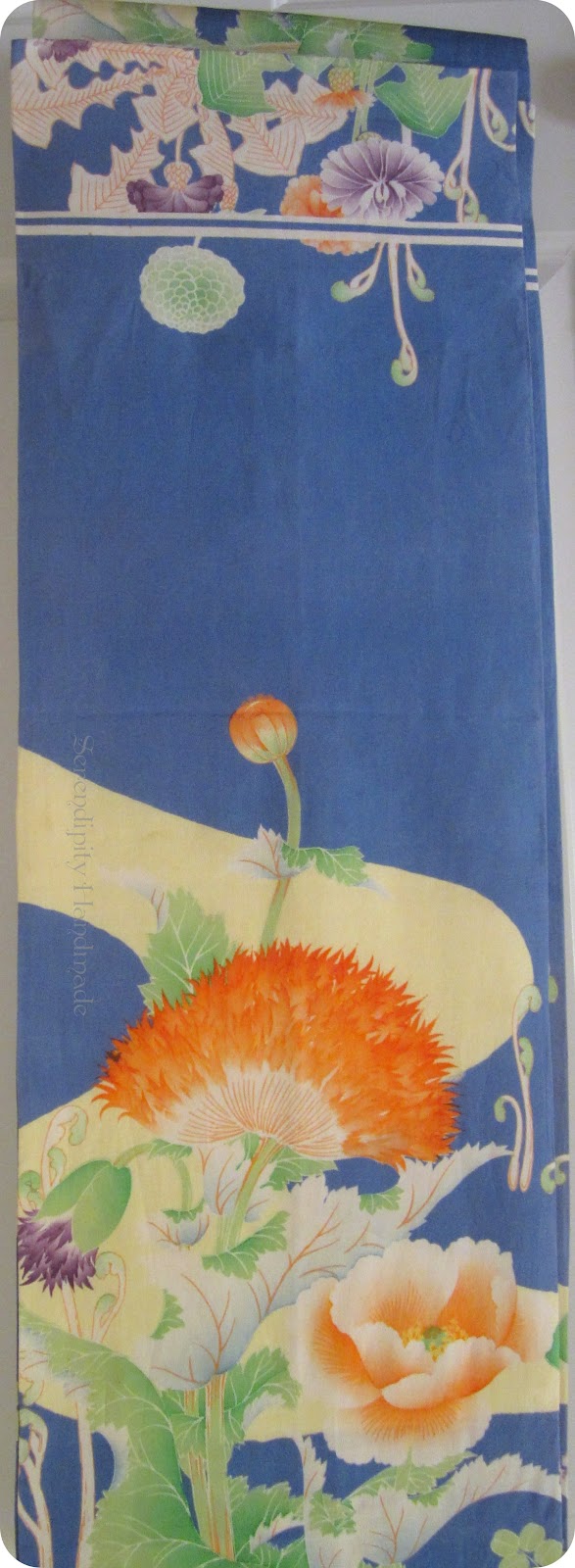
Would you believe that this beautiful kimono obi was found in a trash bag?


This incredible find was originally owned by one of the lovely students in my sewing class, Kiyoko, who lost her battle with cancer a few months ago (but she lived well into her 80s and had a full life).  Her family donated several trash bags full of fabric and fabric scraps to our class, and apparently one her adult children tossed this obi into the bag thinking it was simply a length of fabric!

I practically had to wrestle it away from a fellow student who pulled it out of the bag because she wanted to cut it up to make something new out of it!  I kept begging her not to do it, as it should be appreciated in its current form. I must have been really charming that day because she very graciously gave it to me.

Well, my instructor and I contacted the family to see if they wanted to have this precious item back but they said no, as it did not belong to a kimono.  Lucky me!  I am honored to own Kiyoko's obi as both a beautiful work of art and as a remembrance of a lovely and talented woman.

Draped over a hanger.  It is too long to photograph in its entirety!
Knowing very little about kimono I find this obi to be quite a mystery. First, it is huge at 13 feet long and 14 inches wide.  An amateur conservator that my instructor knows took a quick look at it and guessed that it was probably made mid-century, around the 1950s, but could tell us little else.

So I've done a little research on my own. The fabric seems to be silk and has been wrapped around a somewhat stiff inner core and hand-sewn along one side. It is patterned on both sides. The size, length, and fabric indicate that it should be the most formal type of obi, a maru obi, but it is not nearly as elaborately patterned and embroidered as a maru obi would be.  It is probably a less formal type of obi.


The ends of the obi

My best guess is that it is a fukuro obi.  There is embroidery on both sides, but it is clear even to my inexpert eyes that this obi is meant to be tied in a specific type of knot because the embroidery is heaviest on one side, in one area.  Which knot?  I don't know.  This is the part that is most embroidered and is meant to be showcased:

 
Perhaps it is meant to be tied in a taiko musubi, or a drum-like knot. This is one of the most common obi knots worn today.  Click here for a series of photos showing one method of tying an obi in a taiko musubi.  Complex, isn't it?

It has a few water stains, and what look to be food smudges, so I know this obi has definitely been worn.  It's intriguing. One day I will find an expert in order to solve the mystery of this lovely obi.


{P.S. In case you missed it, Wednesday A. is the winner of the fiber art sculpture giveaway!}

Wednesday, June 6, 2012

Fortunate Finds: 1947 Glide-Tex Pressing Cloth Brochure

A couple of weeks ago I mentioned that I found an unused vintage pressing cloth from 1947 at an estate sale:


I thought that you would like to see the totally cute "How to Press with Glide-Tex" instruction booklet included with the cloth.  Page three includes good basic instructions about how to press-as-you-go for home sewers and dressmakers.

Of course, I still couldn't bring myself to break out my iron and try the actual cloth out considering that it is probably 65 years old and chemically processed in some mysterious way.

The last page is basically an ad for other sewing and pressing-related products that the David Traum Company made.

Enjoy!


Saturday, May 19, 2012

A Variety of Fortunate Finds

I went to two estate sales last week over the past two weeks because I knew that they had vintage sewing patterns.  Now you know I'm de-stashing but vintage patterns are a weakness.  It's not like I need more of them but it's so hard to pass them by....


As it's now estate and garage sale season I'm planning to keep a balance of going to one every so often and not every single week.

I found the cutest apron pattern, McCall 1279 from 1946:

   
I  had to hunt through a lot of scattered pattern pieces that were separated from their envelopes to find this one.  It was worth the extra effort.  I don't have an envelope or the flower transfer but it was still too cute to pass by.  Isn't the bib on View A unusual?  It's now on my list of sewing projects so you'll be seeing it sometime.


I miss the thrill of the hunt and the serendipity of finding an unexpected treasure.  I found about fifteen 1950s and 1960s vintage knitting patterns at one sale and some of the designs are just amazing.  You've seen some of the ads for them before as part of Madison Avenue Monday:


And I now have a cute 1960s-era tissue case for my purse (actually, the lovely Karen of Jenny and Pearl, found a whole set of these and was kind enough to give me one even though we had just met!  Visit her blog because she's having a great giveaway right now):


I found two yards of a very 1960s psychadelic  border print from Starward fabrics.  This is a photo of the lower border.  Amazing, no?


And I found this fabulous Glide-Tex pressing cloth from the 1940s is in perfect condition. I may even break out my iron and ironing board (how likely is that?)!  More about this one in an upcoming post because the how-to-iron booklet inside is so cute:


I couldn't post all of this sooner because this past week or so has been one of those unexpected weeks when I ended up being away from the blog . I have recurrent migraines and they keep me from sitting at the computer long enough to post or really do much besides check my email briefly.  And I have to wear sunglasses when I do that because of the light from the monitor!

Anyway,  what are you up to this weekend?  Are you going thrifting?  Or are you going to indulge in a little crafting time?  If you've got a project or a great find you want to share, I want to see it!  Join my new Flickr group and show us your stuff!

Friday, May 11, 2012

Mother's Work Is Never Done, a Tribute to Moms by Richard Scarry


I went looking for a gift the other day, and in doing so found a new copy of What Do People Do All Day? by Richard Scarry.  It was one of my absolute favorite books in the world as a young child.  The artwork is fun, bright, cheery and amazingly detailed as Scarry gave children a peek at the work-a-day world of making clothes, growing food, baking bread, building roads, and more. 

You can see how beat up well-loved my copy is compared to a brand-spanking new book:

What Do People Do All Day, 1968 vs 1979 abrdiged version, at Serendipity Handmade

I noticed that the newer edition is much shorter. I was surprised to find that four five of the chapters have been removed.  My copy is a first-edition published in 1968. The only edition of this book that you can buy today is the 1979 abridged edition.  How mysterious!  Why abridge a rather popular children's book? What could be wrong with it?

To start, the endpapers with some of the character art have been removed.  In it Scarry drew the residents of Busytown.  I agree that children really don't need to see characters like this anymore:

Spinster Susie, from What Do People Do All Day at Serendipity Handmade blog
Spinster Susie is literally a "spinster" of cotton into thread,
in the "Cotton and How We Use It" chapter (also removed)
However, the chapters about coal and electricity, the water treatment plant, and Sgt. Murphy the Busytown policeman were also removed.  Perhaps the technology in those chapters were a little dated, but frankly most (if not all) of the technology in the other chapters is also outdated.

Ok, but why remove Mother's Work Is Never Done, the chapter about a stay-at-home-mom?  SAHMs still existed in 1979 when the abridged version was published, and they were still working very hard.

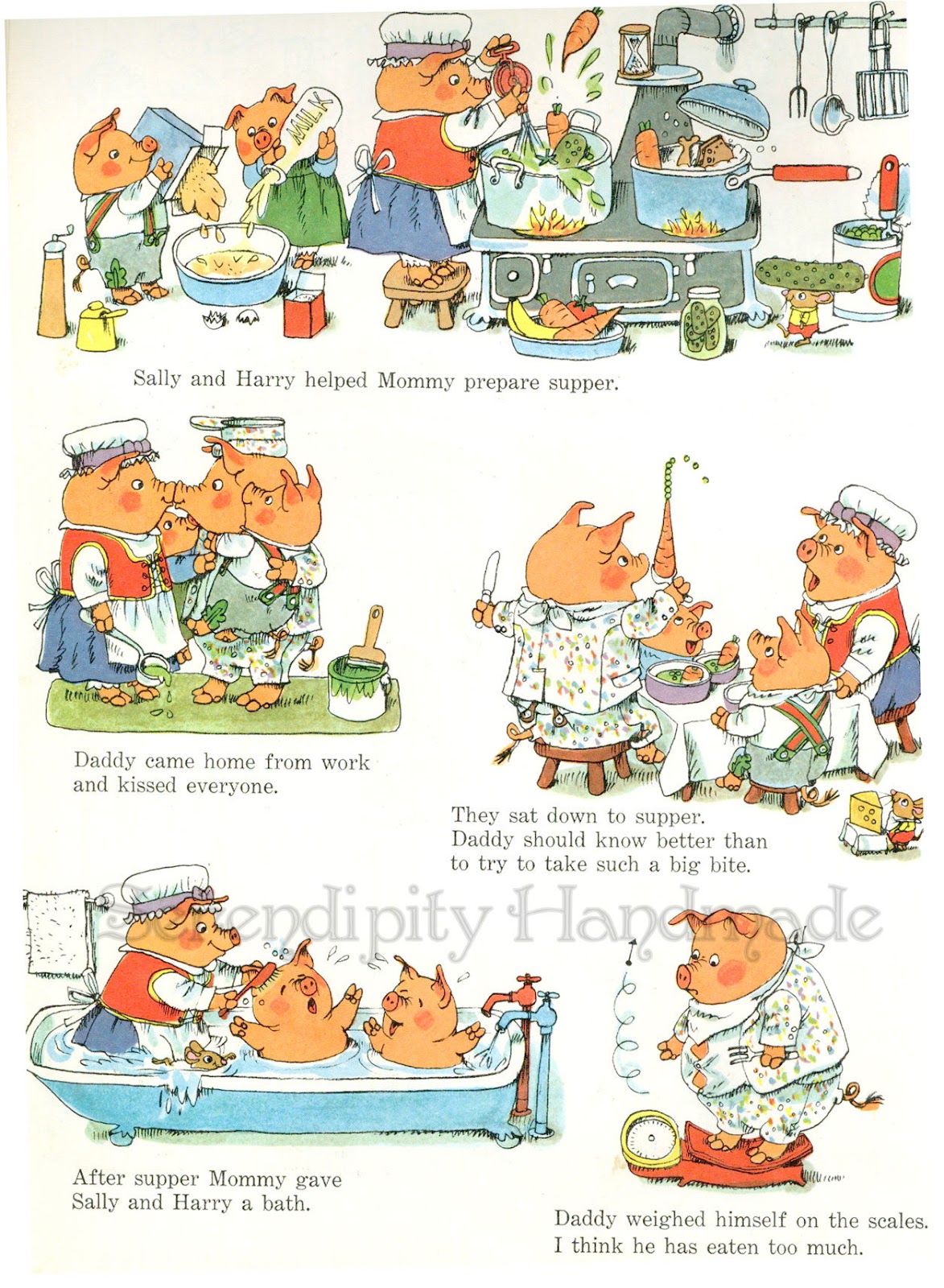
Certainly more women with children entered the workforce in the late 1970s than in the 1960s when this chapter was written.  I imagine that perhaps it may not have been politically correct in the late 1970s to depict a woman / wife / mother / girls in a traditional female role.  In some ways this chapter does reinforce traditional roles.  Scarry does have Daddy Pig and Harry being served breakfast in this chapter, but later Harry rather un-traditionally for the time helps with the housework.  

Personally, I think Scarry was trying to equalize what was traditionally regarded as "women's work" when he wrote this chapter. Even today it's possible that a chapter like this one can help children (and adults) realize just how hard a SAHM works all day, and that the work is equal to the work that her partner does. 

Mother's Work is Never Done from What Do People Do All Day?

Mother's Work is Never Done from What Do People Do All Day?

Mother's Work is Never Done from What Do People Do All Day?

Mother's Work is Never Done from What Do People Do All Day?

Mother's Work is Never Done from What Do People Do All Day?

What do you think?  Is this chapter too dated for 2012?


Either way, I would just like to say Happy Mother's Day
to all you mothers out there, SAHM or not,
and thank you 
because your work really is never done!