Showing posts with label vintage fashion. Show all posts

Thursday, April 25, 2013

Essentials for the Forces and More: free 1940s Knitting Patterns

Did you know that the Victoria & Albert Museum has digitized some World War II-era knitting patterns and made them freely available on their website?  The patterns hail from 1940s publications  such as Woman's Weekly and from booklets like "Essentials for the Forces" by Jaeger Hand-Knit in support of the war effort.


This booklet in particular includes many patterns designed for men and women in the service (such as helmet liners and balaclavas) but there are some truly fashionable gems in this book for those who want to put together an authentic vintage look:

You can download the text of each pattern as a PDF or Word document (I linked to the PDF under each image in this post).  These knitted turbans are my favorite pattern, and the directions look very easy even for slow beginning knitters like myself:

PDF

The "When You're Off Duty" sweater is quite elegant (they are a bit hard to see, but notice that she's wearing dress clips at the collar):

PDF

The lion and tiger toys would make great handmade gifts for a young person (or a young-at-heart person!) today:

PDF

The Victory Jumper (a sweater) is just too cute:

PDF

Check out the rest of the knitting patterns on the V & A site. There is also a section on Ravelry for Victoria & Albert Museum patterns if you need help with directions, especially as the patterns use British knitting terms.


By the way, if you're on Ravelry my username is SerendipityVint. Connect with me!


Images courtesy of Victoria & Albert Museum

Monday, January 14, 2013

Madison Avenue Monday: The Frocks of Downton Abbey


This week's MAM is inspired by the wonderful Downton Abbey.  Enjoy these frocks from Needlecraft Magazine,  June 1926. (My scanner was not quite wide enough for this large format magazine, so a couple of the frocks were cut off on the edge; sorry!).


Monday, November 26, 2012

Madison Avenue Monday: Shades for Evening

The holiday season is upon us!  Time to whip up a little something for those upcoming parties and get-togethers.  Here's a little inspiration entitled Shades for Evening, from McCall's Needlework and Crafts, Fall-Winter 1966/67:


At fall parties, glow in a silvered pink suit, an iced blue long skirt ensemble, or glitter in a sparkle jet dress and twirl at the discotheque in a diaphanous black lace cage! 


Monday, October 15, 2012

Madison Avenue Monday: Color-Blocking

If you've read this blog for a while you know that color-blocking is one of my favorite trends.  I found this fashion spread of knitwear sheaths designed by Sophie Dess in the Spring-Summer 1972 issue of McCall's Needlework & Crafts.  I think that they can definitely stand alongside some of the color-blocked looks for Fall 2012.


Monday, September 24, 2012

Madison Avenue Monday: The Fall Style Story

"The fashion world took quite a hammering this season.  It looked for a while as though we were doomed to appear with skimpy, drooping shoulders; skimpy, no-stride skirts, and all kinds of uncompromising lines....  But, as usual, designers propose and customers dispose, in the good old democratic way, so today we have a 1941 silhouette that makes sense."

Click on the photos to enlarge The Fall Style Story, courtesy Woman's Day, October 1941.

"Long jacket, low set-in belt, wide lapels all point the way to a new trend in suits this autumn. 
Two-piece suit from Davidow."

"Kimono sleeves and slim skirt stamp this fitted topcoat and classic wool dress
as new 1941.  Ensemble designed by Charles Armour."


Thursday, July 12, 2012

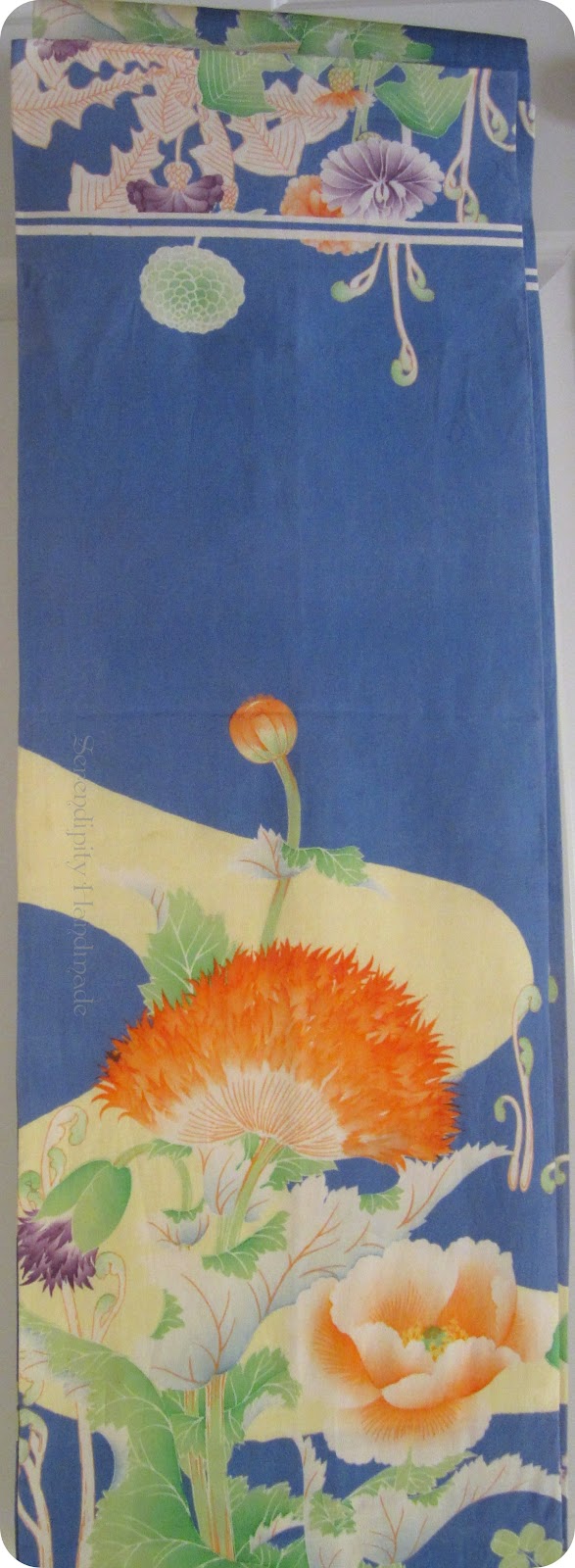
Fortunate Finds: a Mid-Century Kimono Obi

Would you believe that this beautiful kimono obi was found in a trash bag?


This incredible find was originally owned by one of the lovely students in my sewing class, Kiyoko, who lost her battle with cancer a few months ago (but she lived well into her 80s and had a full life).  Her family donated several trash bags full of fabric and fabric scraps to our class, and apparently one her adult children tossed this obi into the bag thinking it was simply a length of fabric!

I practically had to wrestle it away from a fellow student who pulled it out of the bag because she wanted to cut it up to make something new out of it!  I kept begging her not to do it, as it should be appreciated in its current form. I must have been really charming that day because she very graciously gave it to me.

Well, my instructor and I contacted the family to see if they wanted to have this precious item back but they said no, as it did not belong to a kimono.  Lucky me!  I am honored to own Kiyoko's obi as both a beautiful work of art and as a remembrance of a lovely and talented woman.

Draped over a hanger.  It is too long to photograph in its entirety!
Knowing very little about kimono I find this obi to be quite a mystery. First, it is huge at 13 feet long and 14 inches wide.  An amateur conservator that my instructor knows took a quick look at it and guessed that it was probably made mid-century, around the 1950s, but could tell us little else.

So I've done a little research on my own. The fabric seems to be silk and has been wrapped around a somewhat stiff inner core and hand-sewn along one side. It is patterned on both sides. The size, length, and fabric indicate that it should be the most formal type of obi, a maru obi, but it is not nearly as elaborately patterned and embroidered as a maru obi would be.  It is probably a less formal type of obi.


The ends of the obi

My best guess is that it is a fukuro obi.  There is embroidery on both sides, but it is clear even to my inexpert eyes that this obi is meant to be tied in a specific type of knot because the embroidery is heaviest on one side, in one area.  Which knot?  I don't know.  This is the part that is most embroidered and is meant to be showcased:

 
Perhaps it is meant to be tied in a taiko musubi, or a drum-like knot. This is one of the most common obi knots worn today.  Click here for a series of photos showing one method of tying an obi in a taiko musubi.  Complex, isn't it?

It has a few water stains, and what look to be food smudges, so I know this obi has definitely been worn.  It's intriguing. One day I will find an expert in order to solve the mystery of this lovely obi.


{P.S. In case you missed it, Wednesday A. is the winner of the fiber art sculpture giveaway!}

Thursday, April 12, 2012

Fashion Cheats to Save You Money, Part Four of I Hate to Housekeep


It's true these days that most of the clothes that we buy are not built to last for more than a season (or two).  We all love a good bargain and love to show off a great bargain.  But some things we buy simply aren't bargains -- they don't last long enough to make it worth the expense, or worse yet, they look like a bargain (in Peg's words, they look "cheap").

Wouldn't you like some general tips about what type of clothing items you can save money on and still look good, and what you should save your pennies to buy?  In this final part of the I Hate to Housekeep series I'll share some of Peg's advice about your wardrobe that I believe has stood the test of time.


Fashion Cheats to Save you Money, I Hate to Housekeep, Serendipity Handmade
Doesn't the little girl in this Hillary Knight illustration look a lot like Eloise?

First a little advice from me: if you know the item is going to wear out quickly, I suggest buying it from the clearance rack, or even better, at a consignment or thrift store.

A personal example of this are cotton knit t-shirts because they are a basic wardrobe staple that I frequently wear with jeans. Over time they become stained, or the color washes out, or the cotton simply wears so thin that the fabric starts to look cheap. I'm not the type to spend upwards of $20 on a t-shirt so I know that it is best to buy low priced items that can head to the rag bag when they get ratty.

And here is Peg's advice about clothes you can cheat on -- in her words, "buy cheap" -- and get away with it, and those clothing items you should buy to last. Keep in mind that this is 1960s advice, apply it in terms of your wardrobe and lifestyle.  Some of us attend cocktail parties; some of us don't.

What You Can Cheat On
  1. Summer shoes. (You'll have probably worn things like flip-flops and espadrilles out by the end of summer if you wear them frequently).

  2. Summer cottons or synthetic dresses.  Peg says, "Dispose of them at the end of the season because at that point the cheap ones have lost their bounce.  If you don't dispose of them, you'll continue to wear them and they'll look their price."

  3. Cocktail dresses, especially bright ones.  Peg says, "It takes a trained eye to discern the difference between a flame-colored $22.95 number and a flame-colored $98.95 number, particularly after a couple of Gibsons."

  4. Jewelry, if you chose carefully.  (You know that you can get some fabulous-looking vintage costume jewelry at thrift stores, right?)

  5. Handbags, ditto. 

  6. Underwear, depending on your audience, if any.  (Ha ha ha!  Perhaps no one is looking?)

What You Can't Cheat On
  1. Girdles and bras.  (You've seen countless articles in women's magazines about being fitted for the correct size bra.  And the more you spend on your Spanx-like undergarments, the better they will smooth you out and hold you in and the longer they will last.)

  2. Shoes.  Peg says, "The trouble with cheap ones is that they lose their spurious good looks very rapidly but they won't quite fall apart so you go on wearing them."  (You put a lot of pressure and weight on your feet every day.  Whatever the size, shape, and height of the shoe, buy the best-fitting shoe that you can afford in order to problems like corns that occur because of ill-fitting shoes.) 

  3. Belts.

  4. Tailored suits, coats, dresses.

  5. Nylon stockings.  Peg says, "Finding the right brand, size, gauge, and denier can take some doing; but once done, they look much better than the grocery type or factory seconds."  (If you do wear stockings or tights to work, as part of costume events, or for formal events this tip is very true.  Cheap stockings look just that -- cheap.)

  6. Perfume.

  7. Gloves, except for short white cottons.  (Consider this especially if you live in colder climates and wear gloves frequently in fall and winter).
Do you agree with Peg's advice (and mine) Dear Readers?  When it comes to fashion, in what ways do you economize?  Tips, ideas, and stories are always welcome....

Wednesday, March 7, 2012

Pucci

Quickie post:  in sewing class today a collector shared a few pieces from his Pucci collection. Sorry for the low-quality shots (I took them with my phone) and the classroom background, but I just had to share these with you. Years are unknown, but more than likely date from the late 1960s to sometime in the 1970s.


I would love to have the sandals or the rain boots (so cute!).  I particularly love how fresh and modern the cowl neck dress looks with its muted palette of gray, gray-blue, brown, yellow, and chartreuse against the black,white, and yellow geometric  pattern at the hem.

Did you know that Pucci designed sewing patterns for Spadea, McCalls, and Vogue?  Check them out at the vintage pattern wiki.

Saturday, November 5, 2011

Fashion Horizons: Planes and Starlets

I found this 1940s travelogue while poking around the web.  This short film, entitled Fashion Horizons, was sponsored by TWA and Paramount pictures and was designed to showcase up and coming Paramount starlets such as Mary Martin, Martha O'Driscoll, and the beautiful Esther Fernandez (though you will have to ignore how often the narrator references her Latina ethnicity -- I suppose it was a sign of the times).

The fashion is not-to-be missed! This film was also designed to showcase the new fashions of 1941.
There are some truly boring moments where the narrator discussed the features of the latest Boeing airplane, and some discussion of different sights to see, but short fashion moments are interspersed every few minutes in between so don't skip anything.


Most of the action takes place in Albuquerque, New Mexico and at the lovely Camelback Resort in Phoenix, Arizona (it is still in existence as a Mariott property).

Although natural fabrics were king, it is interesting to see how much more synthetic fabric such as rayon and rayon gabardine were used during the time period.

Two of my favorite outfits were the jersey patio slacks suit and the daisy patterned dress with pinafore ruffled sleeves (I just love the bright and cheery fabric!). Enjoy!

Thursday, November 3, 2011

Guest Post: Thoughts on How to Be Vintage

Today we have a special treat: please give a warm welcome to my dear friend Jessica who is guest posting for us today from her wonderful Chronically Vintage blog. 
In this post Jessica talks about her personal style and her thoughts about how to really "be vintage". 
*** 
Of all the questions I'm asked pertaining to my love – and daily celebration - of the past, one of the most common is definitely, "How can I be vintage?".

This query, often posed with great earnest, as though I can see the asker whipping out a notepad and pen inside their head, is always one that takes a moment to answer. Not because I think it's a tricky question per se, but because I think it warrants a solid answer that comes from many years of blending the worlds of yesteryear and today throughout many facets of my life.

My Malcolm Gladwell approved response, the one that has flashed to my mind first on nearly every occasion I've been presented with this particular inquiry, is that a person either is or is not inherently a vintage lover.

That answer, however, may strike some as anything from trite to cute, glib to right on the money, and what I mean by it is that I've never looked at "being vintage", as something I have to work at. It is not an act, a game, or a passing flirtation.

From the earliest days for which I have concrete memories, I can recall being fascinated, enamoured, enchanted, and influenced by the years that occurred before my own lifetime. To me history only truly becomes a part of the ancient past when we stop integrating it into our lives. Being vintage isn't something I decide to be or not to be. I simply am vintage.

{Photographs, such as this immensely glamorous one from 1952 featuring a beautiful model in an equally stunning Dior dress, are amongst my very favourite ways to learn about the decades I hold nearest and dearest to my heart, and which I've longed turned to in my quest to know the past on a very personal level. Image via herecomestheskyon Flickr.} 

But what does that mean exactly? Well, each person who views themselves as a vintage lover surely must define this point on their own terms, but to me it means one who integrates the past (in my own personal case the years spanning the 1930s - 1950s) into their own life in a myriad of ways.

I do not despise or even dislike the present - or the years I've known thorough the last three decades, not at all. Though, I am the first to say that I'm fonder of many elements (not all, but quite a few) from the years that called the mid-twentieth century home.

Like many lovers of bygone days, I'm drawn to - and primarily wear - vintage fashions. Nestled in my modest sized closet one will find skirts and slips, dresses, cardigans, blouses, accessories, hats, shoes, and sundry other wardrobe items that were made during the 1940s or 50s (as well as a carefully curated selection of modern pieces that look very much as though could have been plucked from a department store during those two decades).

My hair and make-up both also adhere to the styles of these fascinating years, and throughout my house one will a selection of items - spanning the spectrum from vintage cookbooks to quaint little woven box housing a selection of authentic vintage sewing patterns that could easily have come from three generations ago.


{Retro Butterick B4918, reissued from the 1950s, is beautifully similar to the Dior gown above}.

Yet being vintage is more than just surrounding myself with - and wearing - the past, though these are certainly important components. For me it is acquiring a solid knowledge of the history, fades, trends, arts, foods, people, and nuisances of the decades I adore most. It’s understanding and appreciating the lives of those who so often exist now only in memories and photographs. There is no one book - or even ten books - that can teach you everything about a whole decade (let alone multiple decades), nor, really, should there be.

The past is meant to be learned as one goes through life, absorbing knowledge from books, certainly, but also from firsthand accounts, stories passed down through the generations. From trips to fact filled museums, second hand stores, plaques on historical building, old movies, art, black and white TV shows, photography, faded magazine pages, the lines of a classic car, internet sleuthing, song lyrics that one topped the charts, venerable homes with charming front porches, handwritten letters discovered in musty attics, in priceless heirlooms and ephemera that was never designed with the purpose of seeing the light of 2011.

It is this knowledge - which one gathers and expands thorough their entire life - that gives a person, I feel, the backbone upon which to build a vintage loving life. With it you are better equipped to seek and find the clothing, home decor, art, and other fascinating items of your favourite decades that you want to bring into your day-to-day world.

Not to contradict what I said earlier on, for I really do think that loving vintage is something that is at least partially ingrained, but one can become a vintage lover at any age. Though I started very young, you can pick up the past any time you like. It's always there, just waiting to be studied and appreciated, absorbed and treasured.

Having a deeply rooted adoration of vintage is a blessing, in my eyes, one that does not fall on everybody's shoulders by any means. It allows you to live beyond the confines of today, this year, even this decade. In choosing - or having the universe choose you - to be a vintage lover, you are making a pact with the past that you're going to celebrate it in the ways that bring you the most happiness every day.

So to those who are curious about “how to be vintage”, I say, quite matter-of-factly, " just be". Seek the past and ye shall find. There is no shortage of history to be researched and loved, worn, embraced and uplifted. Find the years or decades that speak to you the most, learn about and from them, while also filling your world, however much your heart desires, with elements from that era.

If you do, there's a very good chance that before you know it, someone, perhaps while admiring your gorgeous 1940s ensemble, might just stop and ask you how they too can be vintage.

~Jessica
***

Thursday, October 27, 2011

Fortunate Finds: Mod 60s Wallet by Don Loper of California

Thank goodness that this week has been a computer virus-free week because now I can show you this little find:


I haven't been out thrifting or to an estate sale in a while because I've been so good about de-stashing.  But occasionally I can't help myself.  Recently I stumbled over this very mod style, pristine and unused  wallet that I just could not leave behind even though I technically don't need it. 

The wallet is of leather, in an unusual red and bone color combination, with cream taffeta lining and separate compartments for currency, coin, and checkbook. How many leather wallets these days include a petite built in coin purse, separate leather checkbook cover (it's underneath the plastic credit card holder), and  a coordinating gold tone pen?


You see why I couldn't leave it behind.

This gem was designed and produced by Don Loper, under the Don Loper of California label.  Loper started out as a Hollywood costume designer for MGM in the late 1930s and  later, in the 1960s, designed for such luminaries as Ella Fitzgerald.  He is pictured with her mannequin shown below:

via damesofdialogue

Loper also tried his hand at interior design (in posh hotels like the Beverly Hilton), designed men's neckties, and during the 1950s and 1960s produced many lovely dresses under the Don Loper of Beverly Hills label, including the wool suit below:

via Twitpic

This next image is licensed, so you'll have to run over to Flickr to see Loper's amazing mod coat pattern from 1968.  Wish that were mine!  Here is a 60s-era mail order jacket  and blouse pattern that he designed as well:

via carbonated

Perhaps you remember the I Love Lucy episode entitled The Fashion Show that featured Don himself and his salon?  The one where Ricky nearly had a coronary after finding out how much Lucy spent on the dress? All of those hours watching TV as a kid did not go to waste because this episode introduced me to Don Loper!

via GregInHollywood

Finally, enjoy this short clip from the 1943 musical Thousands Cheer featuring Don Loper himself dancing with Maxine Barrat.  He's no Gene Kelly (one of the stars of the film) but it's a cute combination of fashion show and dance number:


Have you found any gems while thrifting or antiquing lately? Do tell!

Wednesday, October 5, 2011

The Skimp: 1974 and 2011

Did you watch Project Runway last week?   Like so many others, I really loved Bert Keeter's sleek color-block mini dress that was produced for Piperlime:

via Lifetime.com
 As you may know, Bert designed in the 1970s so he was well-prepared to meet the design challenge to create a modern look inspired by 70s fashion.

Bert also worked at Halston, the designer who revived the mini-skirt and introduced what he called "The Skimp" in November 1974 for his Spring '75 line.  The raised hemline was big news (read all about it in New York Magazine, December 1974) and gave women another option apart from peasant skirts and maxi dresses. McCall's even produced pattern #4600 in 1975 called "The Real Halston Skimp":

via the Vintage Pattern Wiki


While watching that episode I kept wondering why the judges were making such a huge deal of the little cord belt with silver tips that Bert made to accessorize his dress, as though they had never seen one before. 

I also kept thinking that I'd seen something similar in my pattern collection.  So I dug through part of it and found Vogue Couturier Design 1170 by Belinda Bellville:

via the Vintage Pattern Wiki because I was too lazy to digitize my copy

Clearly this simple A-line silhouette was a popular design choice in the mid-1970s. I'm certainly not trying to stir up any sort of controversy by sharing any of this, by the way.  Bert's look was indeed modern (color-blocking! wide v-neck!) and truly did update a classic 70s look. 

I just have this compelling need to point out to Nina and Michael that the cord belt with the silver aglet tips is not a new idea -- these were mass-produced in the 1970s.  Neither was the flowy A-line silhouette in jersey fabric.  Regardless, Bert  made a fab little dress and it's already sold out!  I think we'll see some knock-offs soon.

In other news, we have a My Memories Suite giveaway winner, chosen by random number: commenter #4, Gustosa of Gustosa Giveaways!

Stay tuned for another fun giveaway coming up soon....

Saturday, October 1, 2011

Fabulous! FIDM Museum Acquisitions Exhibition


I stopped by FIDM a couple of days ago to see the Fabulous! exhibit and boy, was it named well!  My favorite adjective aptly describes this grand tour of Western fashion from the 1800s to the present.  Although I can number the exhibitions I have seen at FIDM on one hand, this one was by far the best and I think they may give LACMA some competition if they continue to produce exhibits of this quality.

I thought I'd share some of the amazing fashions that I saw, though these images will barely scratch the surface of some of the interesting items the museum has collected.  For example, there were two charming wax boudoir dolls from the early 20th century and some amazing (and rather nauseating) chapeaus made from avian taxidermy.

I wish that amateur photographs by everyday people were allowed, but alas, I've gleaned the following from the web to take you on this mini field-trip.

  photo courtesy Peter Wintersteller/abimages


A sumptuous reception dress with jet beads and lace by Charles Worth:

courtesy FIDM Museum blog
 
 Alexander McQueen's beautiful Peacock Dress:
 

photo courtesy Peter Wintersteller/abimages, via Nick Verreos blog

A silk jersey dress designed by Halston, the print is by Andy Warhol:


An extreme pair of men's platform boots circa 1972 or 1973:

courtesy FIDM Museum blog

Mae West's 10-inch platform shoes and her footprint
(she was quite short!):

via Nick Verreos blog 

And one of my personal favorites, a stylish WWII-era propaganda textile dress
made by a home sewist:

courtesy FIDM Museum blog

The dress was sewn from bright patriotic fabric that was produced as a fundraiser for the
British-American ambulance corps circa 1941 or 1942. To read it properly you would need would need to view the dress in a mirror. The fabric states, "There Will Always be an England":

courtesy FIDM Museum blog
If you're local, or will be visiting Los Angeles in the next couple of months, don't miss this exhibit.  I may just visit again myself!

Saturday, January 15, 2011

Book Review and Giveaway: Amy Barickman's Vintage Notions

After the holidays I was asked to review a copy of Amy Barickman's new book, Vintage Notions:  An Inspirational Guide to Needlework, Cooking, Sewing, Fashion and Fun, and I couldn't have received a better present:


This is one of those books that makes my heart go pitter-patter:  it is vintage beauty, cooking, sewing, fashion, and more all rolled up into one adorable book that has been lovingly filled with vintage images from Amy's personal collection. Amy and I have this in common -- we both love to collect sewing and needle arts books, vintage home arts magazines and cookbooks, as well as sewing textiles, ephemera and handiwork projects. Vintage Notions is exactly the type of book that anyone who loves vintage and antique domestic arts will adore.

Many of us who collect antique and vintage know about the amazing founder of the Woman's Institute of Domestic Arts & Sciences, Mary Brooks Picken, who was a pioneer in sewing and fashion.  Founded in 1916, the Woman’s Institute of Domestic Arts & Sciences became the largest vocational school in history that was solely devoted to teaching women how to combine the domestic arts with entrepreneurship.  Mary was a woman ahead of her time (women hadn't even earned the right to vote when she founded the Institute)!

In Vintage Notions Amy decided to collect some of the best of the Institute's newsletters to introduce Mary Brooks Picken's work to us modern women. Mary wrote nearly 100 books on sewing and dressmaking in her lifetime, but her beautifully illustrated newsletters that she and her colleagues wrote for the Institute are little works of art. The newsletters are filled with inspirational essays, clever sewing patterns, beauty tips, fashion basics, and tasty recipes, like this Department of Cookery entry for January that begins:


There is a new project for each month of the year, including the instructions for twelve "Magic Patterns" from which you can make some really lovely sewing projects, like this 1920s lingerie set:


Amy also shares advice and plenty of modern tips and techniques throughout Vintage Notions, and many of the charming illustrations are from her vintage collections. The book is organized by season, and one of the little details that I really like about this book is that each season has its own storage pocket for saving fabric swatches or notions or notes about the projects or recipes that you've made, as a kind of journal of your creativity:


Would you like to have your very own copy of Vintage Notions?  Well, you can't have mine! (smile) This is a keeper and is going straight into my personal collection.  Happily, Amy has generously offered a copy to giveaway to a Serendipity Handmade reader!

You can see more sample pages from the book here. To enter, just leave comment with your thoughts about Vintage Notions by 11:59 PST on Friday, January 28th, and I'll choose a winner by random number to be announced on January 29th.  International entries are welcome too.

If you'd like extra chances to win here are some options; please leave an additional comment for each entry:
  • Like Serendipity Vintage on Facebook
  • Follow Serendipity Vintage on Twitter
  • Tweet about this giveaway (be sure to use @SerendipityVint in the tweet)
  • Blog about this giveaway (place the link in your comment)
  • Share this post on your Facebook page (place the link in your comment)
  • Stumble this post
  • Subscribe as a new follower to Serendipity Handmade through Google Friend Connect
Best of luck to you all!